
Published · Updated
Industrial solar ROI in Pakistan is becoming an important consideration for businesses looking to reduce electricity expenses and improve long-term energy security.For industries and large businesses in Pakistan, electricity is one of the most important operating expenses. Factories, manufacturing units, warehouses, processing plants, cold storage facilities, textile units, food industries, pharmaceutical companies, and other industrial operations depend heavily on reliable electricity to keep machinery and production processes running.
As energy costs become an increasingly important factor in business profitability, industrial owners are looking for ways to reduce electricity expenses and improve long-term energy security. One of the most attractive solutions is industrial solar energy.
Solar power allows industries to generate electricity from sunlight instead of purchasing all of their electricity from the grid. For a business making a large investment in solar, however, an important question is:
What is the ROI of an industrial solar system in Pakistan?
Return on Investment, commonly known as ROI, helps businesses understand whether the money invested in a solar system can generate sufficient financial savings over time.
The actual ROI of an industrial solar project depends on several factors, including system size, installation cost, electricity consumption, electricity tariffs, solar generation, daytime load, financing, maintenance, and the applicable regulatory framework.
Pakistan has strong solar resources. A World Bank solar-resource assessment reports yearly global horizontal irradiation across most of Pakistan in the range of approximately 1,600–2,200 kWh/m², corresponding to estimated specific PV output of around 1,400–1,900 kWh per kWp per year.
This makes solar a potentially valuable long-term energy investment for industrial businesses.For industrial businesses, understanding industrial solar ROI in Pakistan can help in making better long-term energy investment decisions.
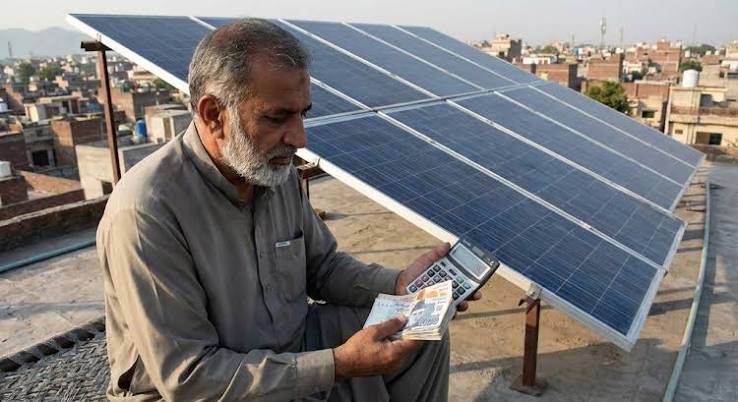
What Does Industrial Solar ROI Mean?
Industrial solar ROI refers to the financial return a business receives from investing in a solar power system.Industrial solar ROI in Pakistan helps businesses evaluate whether the electricity savings generated by a solar system justify the initial investment.
In simple terms:
Solar Investment → Electricity Generation → Electricity Savings → Payback → Long-Term Financial Benefit
When an industrial facility installs solar panels, the system generates electricity over many years. That electricity reduces the amount of power the company needs to purchase from the grid.
The value of the electricity generated becomes the primary financial benefit of the investment.
A simplified ROI analysis considers:
- Initial solar system cost
- Annual solar electricity generation
- Electricity cost avoided
- Operating and maintenance costs
- Financing costs
- Battery costs, if applicable
- Applicable taxes and charges
- Export or compensation arrangements, where applicable
- System degradation
- Future electricity price changes
Because these factors vary from project to project, there is no single ROI figure that applies to every industrial solar installation in Pakistan.
Why Industrial Businesses in Pakistan Are Investing in Solar
Industrial facilities typically consume much more electricity than residential properties.
A factory may operate motors, pumps, compressors, HVAC systems, production machinery, lighting, refrigeration, conveyors, and other heavy electrical equipment.
If electricity represents a large part of the operating budget, even a percentage reduction in grid electricity consumption can create meaningful financial savings.For industries with high daytime electricity consumption, industrial solar ROI in Pakistan can become more attractive because solar power can directly offset grid electricity usage.
Solar is particularly attractive for industries that have substantial daytime electricity consumption, because solar panels generate electricity primarily during daylight hours.
Instead of generating solar power and exporting a large portion of it, an industrial facility can directly use the electricity for its own operations.
This can improve the economic value of solar investment.
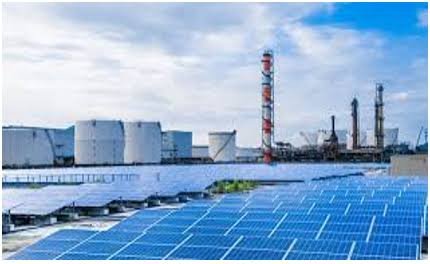
How Industrial Solar Generates ROI
The basic financial mechanism is straightforward.
During daylight:
Sunlight → Solar Panels → Inverter → Industrial Loads
The factory uses the solar-generated electricity to operate its machinery and equipment.
If the solar system generates 500 kW of electricity at a particular moment and the facility is consuming 450 kW, the available energy can be used by the facility according to the system configuration, while any excess may be subject to applicable grid-export arrangements.
The greater the amount of solar electricity that replaces electricity the business would otherwise purchase, the greater the potential savings.
This is why self-consumption is an important factor when calculating industrial solar ROI.Self-consumption is therefore one of the most important factors when evaluating industrial solar ROI in Pakistan.
Key Factors That Determine Industrial Solar ROI
1. Solar System Installation Cost
The initial investment is one of the most important factors in ROI calculations.
Industrial solar costs can vary depending on:
- System capacity
- Solar panel technology
- Inverter selection
- Mounting structure
- Electrical equipment
- Protection systems
- Installation complexity
- Roof or ground-mount requirements
- Monitoring equipment
- Engineering and design
- Battery storage
- Grid interconnection requirements
A 100 kW project will naturally have different economics from a 1 MW industrial solar project.
Therefore, businesses should request a detailed project quotation rather than relying on a generic per-kW price.Accurately estimating installation costs is essential for calculating realistic industrial solar ROI in Pakistan.
2. Electricity Consumption
The second major factor is how much electricity the industrial facility consumes.
An industry with a high monthly electricity bill has more potential for solar savings than a facility with very low consumption.
For accurate analysis, businesses should review several months of electricity bills and examine:
- Monthly kWh consumption
- Peak demand
- Billing structure
- Operating hours
- Seasonal consumption
- Daytime consumption
- Night-time consumption
The more accurately the consumption profile is understood, the more accurately the solar system can be designed.A detailed electricity consumption profile can make industrial solar ROI in Pakistan calculations more accurate and useful for decision-making.
3. Daytime Load Profile
Daytime energy consumption is especially important for industrial solar ROI.
Solar panels produce electricity during daylight hours.
If a factory operates from 8 AM to 6 PM and consumes substantial electricity throughout those hours, solar generation can directly offset its grid electricity consumption.
For example, a manufacturing facility operating heavy machinery during the day may be able to use a large portion of its solar generation internally.
This can improve the financial performance of the project.A strong daytime load can improve industrial solar ROI in Pakistan because more solar-generated electricity can be consumed directly by the facility.
4. Solar Resource and Energy Generation
Pakistan has strong solar energy potential.
According to the World Bank’s Pakistan solar resource assessment, most of the country receives approximately 1,600–2,200 kWh/m² of annual global horizontal irradiation, while estimated PV electricity output is approximately 1,400–1,900 kWh per kWp annually depending on location and conditions.
Actual production at a specific industrial site will vary based on:
- Location
- Panel orientation
- Tilt
- Shading
- Temperature
- Dust
- Equipment efficiency
- System design
- Maintenance
- Weather conditions
Therefore, a professional solar feasibility study should use site-specific solar data rather than relying only on national averages.Actual solar generation should be carefully estimated when calculating industrial solar ROI in Pakistan for a specific facility.
5. Electricity Tariffs
The value of solar electricity depends heavily on the electricity cost it replaces.
If an industrial business pays a high effective cost for grid electricity, every unit of solar electricity consumed internally can represent a larger potential saving.
However, industrial electricity bills can contain different components, including energy charges, demand-related charges, taxes, adjustments, and other applicable components.Electricity tariffs directly influence industrial solar ROI in Pakistan because they determine the financial value of each unit of solar electricity consumed.
6. System Size
The right system size can have a major impact on ROI.
A common mistake is assuming that the biggest possible solar system will automatically provide the highest financial return.
That is not necessarily true.
The ideal system should be based on:
- Actual electricity consumption
- Available rooftop or land area
- Daytime load
- Grid connection
- Export arrangements
- Future expansion
- Budget
- Financing
- Backup requirements
For some businesses, a system designed primarily around self-consumption may provide better economics than simply maximizing installed capacity.Choosing the appropriate system capacity is essential for achieving a realistic industrial solar ROI in Pakistan.
7. Battery Storage
Battery storage can add significant value to an industrial solar system, particularly when backup power is important.
A hybrid system can store excess solar energy and make it available later.
However, batteries also increase the initial investment.
Therefore, battery ROI should be evaluated separately.
Businesses should consider:
- Battery capacity
- Required backup duration
- Critical loads
- Battery technology
- Expected cycle life
- Replacement cost
- Energy management strategy
For an industry whose primary objective is reducing daytime electricity costs, batteries may not always be necessary.
For an industry where power reliability is critical, battery storage may provide important operational value in addition to direct financial savings.
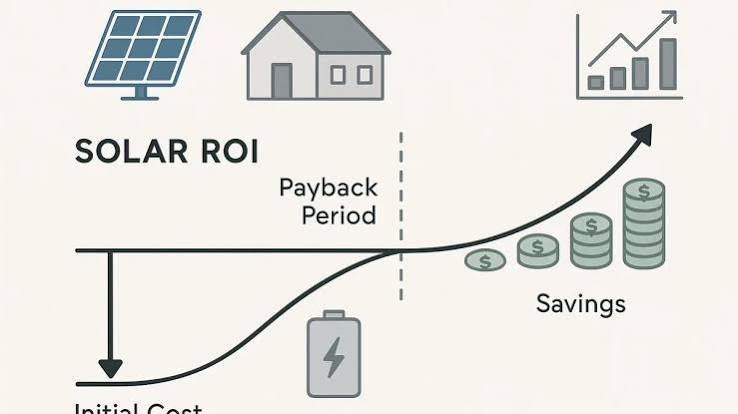
How to Calculate Industrial Solar Payback Period
The payback period is one of the easiest ways to understand a solar project’s financial performance.
A simplified calculation is:
Payback Period = Total Solar Investment ÷ Annual Net Savings
For example, suppose an industrial solar project costs PKR 30 million and generates an estimated PKR 7.5 million in annual net electricity savings.
A simplified payback calculation would be:
PKR 30 million ÷ PKR 7.5 million = 4 years
This is only an illustrative example, not a guaranteed market payback.
Actual results may differ because electricity prices, solar production, maintenance, financing, system degradation, taxes, and regulatory arrangements can change.
Simple Example of Industrial Solar ROI
Consider a hypothetical factory installing a solar system.
Assume:
- Initial investment: PKR 30 million
- Estimated annual savings: PKR 7.5 million
- Annual maintenance and other costs: included in the net savings estimate
The approximate payback period would be:
30 ÷ 7.5 = 4 years
After the initial investment is recovered, the electricity generated by the system can continue to provide economic value over the remaining operating life of the equipment.
This is why industrial solar should be evaluated as a long-term investment, rather than only as a monthly electricity-saving tool.
What Is a Good Industrial Solar Payback Period?
There is no single payback period that is considered correct for every industrial project.
A project’s payback can vary based on:
- Installation cost
- Electricity tariffs
- Solar generation
- Daytime consumption
- Financing
- System size
- Battery inclusion
- Export arrangements
- Maintenance
- Future energy prices
Many businesses use payback period alongside other financial indicators such as:
- ROI
- Internal Rate of Return (IRR)
- Net Present Value (NPV)
- Levelized Cost of Electricity (LCOE)
- Cash flow analysis
For large industrial investments, using multiple financial metrics gives a more complete picture than relying on payback alone.
Frequently Asked Questions (FAQs)
1. What is industrial solar ROI?
Industrial solar ROI is the financial return generated by investing in a solar energy system for an industrial facility. It is mainly based on the investment cost, electricity savings, system performance, operating costs, and other financial factors.
2. What is the typical payback period for industrial solar in Pakistan?
There is no fixed payback period for every project. It depends on system cost, electricity consumption, tariffs, solar generation, financing, maintenance, battery requirements, and applicable grid-export arrangements.
3. Is industrial solar a good investment in Pakistan?
It can be a strong long-term investment for industries with significant electricity consumption, particularly when a large portion of electricity is consumed during daylight hours.
4. How is industrial solar ROI calculated?
A simplified calculation is:
Payback Period = Total Solar Investment ÷ Annual Net Savings
For a complete investment analysis, businesses should also consider IRR, NPV, financing costs, maintenance, degradation, and regulatory factors.
5. Can solar reduce factory electricity bills?
Yes. Solar electricity can replace a portion of the electricity that a factory would otherwise purchase from the grid, potentially reducing electricity expenses.
6. Does industrial solar work during cloudy weather?
Solar panels can still generate electricity under cloudy conditions, but production is generally lower than during strong sunlight.
7. How much electricity can industrial solar generate?
Generation depends on system capacity, location, panel orientation, shading, equipment efficiency, weather, and maintenance. Pakistan has strong solar potential, but site-specific modelling should be used for project estimates.
8. Should factories install batteries with solar?
Not every factory needs batteries. Batteries are most useful when backup power, energy storage, or greater energy flexibility is a priority.
9. Can industrial solar provide backup power?
A hybrid solar system with appropriately sized batteries can provide backup for selected industrial loads. The backup capacity depends on battery size, inverter capacity, and the loads connected to the backup system.
10. Is net metering included in industrial solar ROI?
Potential grid-export arrangements can affect project economics, but the applicable rules and compensation mechanisms should be confirmed under the current regulatory framework before calculating ROI.
📍 Office: MM Tower, Plaza 54, KB Commercial Road, Lahore
📞 Phone: +92 319 9903998
📧 Email: Info@ecogreensolars.com
🌐 Website: www.ecogreensolars.com
#IndustrialSolar #SolarROI #SolarROIinPakistan #SolarPakistan #IndustrialSolarPakistan #CommercialSolar #SolarEnergy #SolarPower #SolarPanels #SolarInvestment #SolarSavings #IndustrialSolarSystem #SolarForFactories #FactorySolar #RenewableEnergy #CleanEnergy
Need help with your solar or electrical work?
EcoGreen Solar installs solar systems and provides electricians, wiring and CCTV across Lahore and Punjab. Get a free survey and a written quote.
Call / WhatsApp 0319 9903998 Request a free quote
Related: Commercial & industrial wiring · Solar installation services · Cities we serve